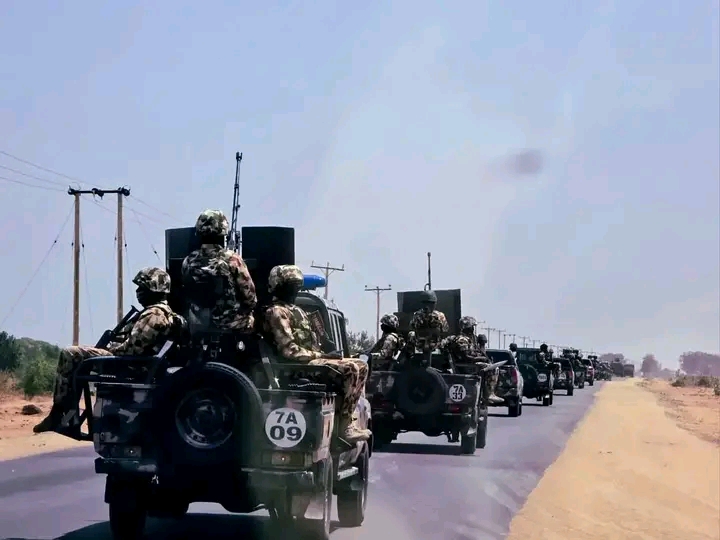
The Nigerian Army, under Operation Hadin Kai, has achieved significant gains in the fight against insurgency in the North-East by intensifying targeted offensives against key leaders and strongholds of the Islamic State West Africa Province (ISWAP) and Boko Haram (JAS).
Maj.-Gen. Abulsalam Abubakar, Theatre Commander of the North East Joint Task Force (Operation Hadin Kai), disclosed this during an interview with the News Agency of Nigeria (NAN) in Maiduguri on Friday.
Abubakar stated that, despite some recent attacks and losses, troops have continued to tighten the noose on the terrorist groups, gradually reshaping the security landscape across the region. He emphasized that the Nigerian Army, in close coordination with its Air Component under Operation Hadin Kai, has sustained aggressive operations focused on dismantling insurgent command structures, disrupting logistics networks, and denying terrorists freedom of movement in critical areas of Borno State.
Key Breakthroughs in Leadership Neutralization
Among the most notable successes was the neutralisation of Modu Kundiri, a top ISWAP commander and Qa’id (leader) of the Pulka axis in Gwoza Local Government Area. Kundiri was eliminated during a coordinated ground operation along the Madagali–Gwoza axis — a strategic corridor linking the Sambisa Forest and the Mandara Mountains. His death has reportedly created leadership uncertainty and disrupted command and control within ISWAP ranks in that sector.
In Kukawa Local Government Area, troops eliminated Malam Bako Gorgore (also known as Abou Mustapha), a senior member of ISWAP’s Shura Council. He was responsible for high-level operational planning, recruitment, and ideological indoctrination.
Airstrikes in the Yuwe axis of the Sambisa Forest also accounted for several high-value targets, including commanders identified as Saddam, Saleh Garin Kago, Hussaini Ubaida, and Ba Alayi Benbem. These strikes targeted command centres and logistics hubs.
Internal crises within ISWAP have further compounded the group’s losses. Abu Kasim was reportedly killed by an improvised explosive device (IED) planted by rival faction members, while Abu Nazir was eliminated during internal purges linked to factional disputes.
Air and Ground Operations
The Air Component has played a decisive role through intelligence-led missions, destroying command centres, logistics hubs, and neutralizing clusters of fighters in the Sambisa Forest. In the Ngoshe–Pulka corridor, rapid-response airstrikes eliminated more than 50 insurgents after a failed attack, showcasing improved surveillance and coordination between ground and air assets.
In one of the most significant recent engagements, troops successfully repelled a major ISWAP assault on a military formation in Malam Fatori, Abadam Local Government Area, killing 84 terrorists, including several senior field commanders. The attackers employed advanced tactics, including armed drones, but were met with coordinated ground fire and precision airstrikes. Weapons, explosives, and other equipment were recovered during the operation.
Sustained Pressure on Terrorist Enclaves
Abubakar noted that these operations are deliberate and intelligence-driven, aimed at systematically dismantling the operational backbone of the insurgency. Troops have continued to hold their ground, repel incursions, and push deeper into terrorist enclaves in the Sambisa Forest, the Timbuktu Triangle, and along the Lake Chad shores.
“While the security situation remains fluid, the sustained targeting of insurgent leadership, combined with precision airstrikes and improved battlefield coordination, is tilting the balance in favour of our forces and has significantly reduced the operational capacity of the insurgent groups,” the Theatre Commander added.
The military continues to urge vigilance and support from local communities as operations intensify to restore lasting peace in the North-East. (NAN)